
Santiago
So, quickly through Santiago. It’s cool. I can imagine living there (you’ll have noticed by now that that’s kind of the benchmark I use). Dense, but not European dense, lots of bars/restaurants/cafes with outdoor seating, different neighborhoods with different vibes. Dig it. The pretty extensive network of bike paths & lanes also touched a soft spot in my heart. Obviously.

Something you probably did(n’t) know
The US, as it does with many countries, has a complicated relationship with Chile. In 1970, Chile democratically elected Salvador Allende, a socialist. This made Nixon and Kissinger shit their pants, fearing that Chile would then align itself with countries like Cuba and Russia and shift the entire region towards more eastern-looking politics. They couldn’t intervene directly because he wasn’t a dictator (damn democracy!) so they tried to destabilize the government to the extent that it would fall by using a fake news campaign, lambasting socialism, saying the Russians were going to invade, and that Russians eat babies. That didn’t work, so they crippled the economy, like in Cuba, resulting in a lack of availability of basic products like bread and milk, long queues, and exactly the “proof” it needed to show socialism was bad; so bad indeed that Chileans weren’t all that miffed when the military overthrew the government (which, surprisingly, the US was not actively involved in. We were happy it happened, but we didn’t pull the triggers). Very bad. Then they installed Pinochet and helped him craft an insane neo-liberal constitution which outsourced everything to Adam Smith’s invisible hand and a hard-core unregulated market, figuring that they could experiment in Chile with policies they could only dream of implementing in the US. And it worked. Chile’s economy took off and it quickly became the economic powerhouse of South America. (I should add here that the country was still very social in many ways, as free education and healthcare were guaranteed, it simply wasn’t the government doing the direct provision). Very good. So anyway, neo-liberals preach the “Chile case” as proof that “socialism bad, capitalism good,” and Chileans, apart from those in opposition who get disappeared (about 3000 murdered, another 37,000 imprisoned or tortured), enjoy their new found wealth. The government (Pinochet) was so confident that they were in the good graces of the citizens that they held a referendum on whether to continue the dictatorship, and they lost. Suckers. But Chileans kept the constitution. That was bad, because collusion and cartel behavior were legal (praise be to the invisible hand), and turns out, fairly widely practiced. So major companies got caught, no one got punished, and then the metro company raised prices and it was the straw that broke the camel’s back. People went nuts, rioted, looted, etc., and achieved a major goal, which was a chance to draft a new constitution. They did this, but rather than use a wide body of stakeholders including constitutional lawyers, they used people with opinions and reach, but no knowledge. Welcome to the age of influencers! And then their newly drafted constitution got voted down. And then they did it again, made the same mistake on stakeholder involvement, and lost again. So the economy isn’t doing so great and the country is saddled with a constitution its citizens don’t really like, creating so much uncertainty that foreign direct investment has dried up, large Chilean companies are offshoring, and the country is in crisis. Wild ride. And perhaps unsurprising then that it isn’t discussed much in public. Like Michael Jackson now!
I know that was long, but I find the whole “something bad led to something good which was maybe too good to be true and now we’re polarized to the point that we’re paralyzed in a shitty but resolvable situation” fascinating, all the more so because it was triggered by the US government and it certainly wasn’t taught when I was in school. Strange to learn of the skeletons in my closet by one of the victims.
Patagonia here I come
So after Santiago, I started what I thought would be a three-day journey south to the southernmost point of the Carretera Austral. Fly day 1, 8 hours on a bus day 2, another 8 day three. Except my info was outdated, so I had a layover day between each travel day and am now two days behind wherever I would otherwise have been. Fine, I’m on Patagonia time now, wherever I am is the right place, right time.
I’ve been thinking about a few things as this gets closer and closer to becoming reality. One, will I eventually get bored of the scenery? The average scene will be spectacular, so will spectacular become average? “God, if I have to see one more U-shaped valley…” I don’t think so, but who knows.
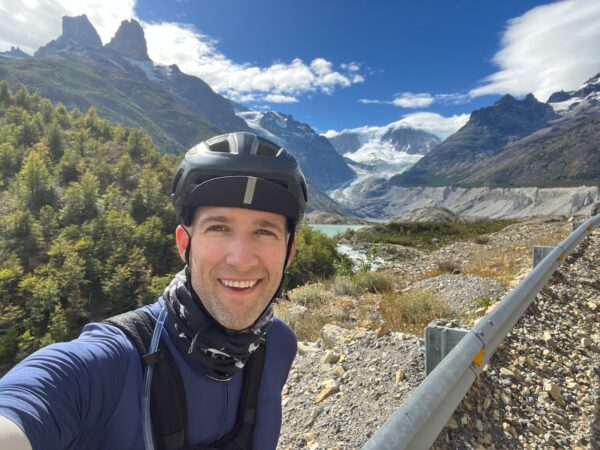
(Not bored yet)
Two, how am I going to react if the weather is shitty, everything is shrouded in clouds, and I can’t see anything? This would suck, royally. I will no doubt still be able to see some things, and what I see will be beautiful, and maybe it’ll make me even more appreciative of the sunny days, but yeah…I really don’t want the weather to rain on my parade.
And three, am I ready for this? I think…yes. I’ve never needed to think about fueling for multiple days, so it’s an added twist, but I think I’ve got a good plan. Beyond that, I have three cycling kits, three wool shirts, and four pairs of travel undies, so I am optimistic that I could go basically a full week with no washing and still not be completely disgusting. I’m a convert to wool shirts for travel, I think I could wear these three shirts for a month and not “need” a wash. If a cyclist stinks in the woods but nobody is around to smell him, does he actually stink?
The first day of northward-bound cycling starts tomorrow (March 7th). I think I’ll be camping or wild camping two-thirds of the time, the other third in budget accommodation. Which probably means less frequent writing because I have no electricity. Or more frequent because I have nothing else to do. Don’t know. Let’s find out.