
Curious about how one goes about planning a long cycling trip in countries one has never visited? Here’s how I’m tackling it:
Step 1: Get your bearings
Start with a little bit of research. If you’re in Europe, popping over to https://en.eurovelo.com/ is an absolute must, if for nothing more than inspiration for your route planning. If you’re anywhere else, well, don’t be too bummed, the mapping tool in step 2 has overlays of cycling routes all over the world.
After that, search the webs for organized cycling trips in the areas/countries you want to go through; they may not provide route files (gps/gpx/tcx), but they definitely have cultural and natural highlights to inspire you. Make note of the tour agencies, they may come in handy later.
Step 2: Rough route planning
In my digging, I discovered this site: https://cycle.travel/map. It’s brilliant. You plug in the points you want to hit (no distance is too great), and it will calculate an “optimal” route for you, based on a number of criteria like: size of road; surface quality; (dedicated) cycle lanes; tolls; official cycling routes; etc.
With the route calculated, the tool tells you distance, elevation, and distance traveled per road surface type. Pretty cool.
Step 3: Refining the route
Once cycle.travel has given you a suggestion, zoom in on the route, find the bigger (relatively speaking) towns on your route, and google “best things to see near ___”. Or, shit, do it for the whole country. The world is your oyster! Your eyes and your curiosity will thank you, but your legs and your ass might not, because obviously this tends to make trips longer. Anyway, find things that interest you, and adjust your cycle.travel map accordingly.
Step 4: The first itinerary
It’s at this point in time when a first version of an itinerary starts to get useful. When you’ve defined the highlights and refined your cycle.travel map, you probably want to plan extra time for them. And you want to know how far you’re going to ride in a day. Look at your map, and look for towns that fit your distance profile. Well, I’m looking at towns, because I’m a bit of a princess and think the idea of a shower and a real bed after a long day of cycling is nice. You may not be as high-maintenance as I am. Annnnyway, you know what you want to budget extra time for, you know how much time you want to spend on the bike each day, and you start to get nerdy in excel. Departure city, destination city, distanced traveled, nights at destination, etc. Beautiful. Click here to see my plan.
Side note: I’m planning to average about 100km per cycling day. And a disclaimer: I’m an idiot and have never toured before and therefore can’t judge how far I’ll be able to go before going into dark places mentally. I like (am obsessed with) cycling though, so I’m not afraid of long days. I’ve done plenty of 5+ hour rides on a road bike, so I’m hoping 100km touring is also fine, but only time will tell. Pun intended.
Step 5: Interlude – back to the blogs
At this point in time, it’s a good idea to go back to researching. Look for blogs about bike touring in the areas you’re traveling in. A few good resources:
- https://www.crazyguyonabike.com/
- https://www.bikeforums.net/touring/
- https://www.reddit.com/r/bicycletouring/ (also can go to …/r/bikepacking)
With more detail in your route, you can look for people who have ridden in the same areas, and hopefully find some very specific advice or experience. Maybe they have tips on hidden gems, road quality, restaurants, interacting with locals, how scary the feral dogs are, etc. Feel free to reach out to them. I haven’t yet, but I assume they are friendly ;).
Step 6: Getting granular with Strava and Google maps (and another round of refining)
Now comes the very time-consuming part. But fun. I’m a cycling geek, a bit of a data geek, and I enjoyed this. Anyway. you’ve got your cycle map in front of you, you’ve got a tab open to Google maps, and you open up Strava. Go to https://www.strava.com/routes/new, look on the left side of the map for the gear icon (orange in the photo below), click on it, toggle the “global heatmap” switch, and watch the roads light up red. At least the popular ones. Now, essentially, you have a massive dose of “free local knowledge” (though the heatmaps aren’t always perfect).

Navigate your Strava map, your Google map, and your cycle map to your desired starting point, and start mapping on Strava. Hopefully, the roads cycle.travel recommended are bright red on Strava. If not, turn to Google, and check out the street view for the Strava option and the cycle.travel option. Should give you enough information to go on to make a choice. I don’t think you can go wrong with either, but hey, I’ve never used cycle.travel before, and I have no idea if Strava heatmaps work well in eastern Europe, so my opinion is worth nothing here.
Build your route on Strava, checking elevation profiles along the way. Elevation gain will have a major influence on how far you ride (duh), so don’t neglect this. Save, rinse, and repeat.
Step 7: Begging for knowledge from locals
Remember those cycling shops and cycle tour agencies you found earlier? Write them, tell them your story, send them your routes (the ones you just built up on Strava), and ask if they have tips. Some areas of cities may be dodgy. Some roads may be unknown but beautiful. You already have none of their knowledge, so even if they don’t respond, you haven’t worsened your position ;).
Step 8: Finalization and turn-by-turn directions
Unfortunately, Strava routes don’t give turn-by-turn directions on my bike computer. Fortunately, other options do. So d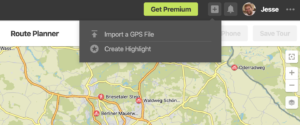 ownload your Strava routes in either .gpx or .tcx format, and upload them either to Komoot or to RideWithGPS (I highly recommend Komoot; 30 euros for a lifetime of updated, offline maps with turn-by-turn directions). For Komoot, go to https://www.komoot.com/plan/, then click on the plus icon in the top right corner (pictured), click on “import a GPS file”, and Komoot does the rest. Then, download your routes from Komoot to your bike computer, and you’ve got turn-by-turn directions!
Caveat
I will have to come back and let you all know how this works. I’m hopeful it’s great. Obviously. If I thought it would work out poorly, I’d use a different method ;)